The ABCs of THC: Cannabis THC vs. Hemp-Derived THC
ANJA · August 27, 2025
The ABCs of THC: Understanding THC and Its Different Sources
If you have walked into a gas station or a smoke shop lately and seen jars labeled "THCA flower" or "Delta-8 flower," you have probably wondered how those products relate to what you find on the shelf at a licensed dispensary. You are not alone. At ANJA, our team noticed customers reading the same lines on a Certificate of Analysis with extra caution, especially around the "THCA" number, and asking good, specific questions about where different kinds of THC come from.
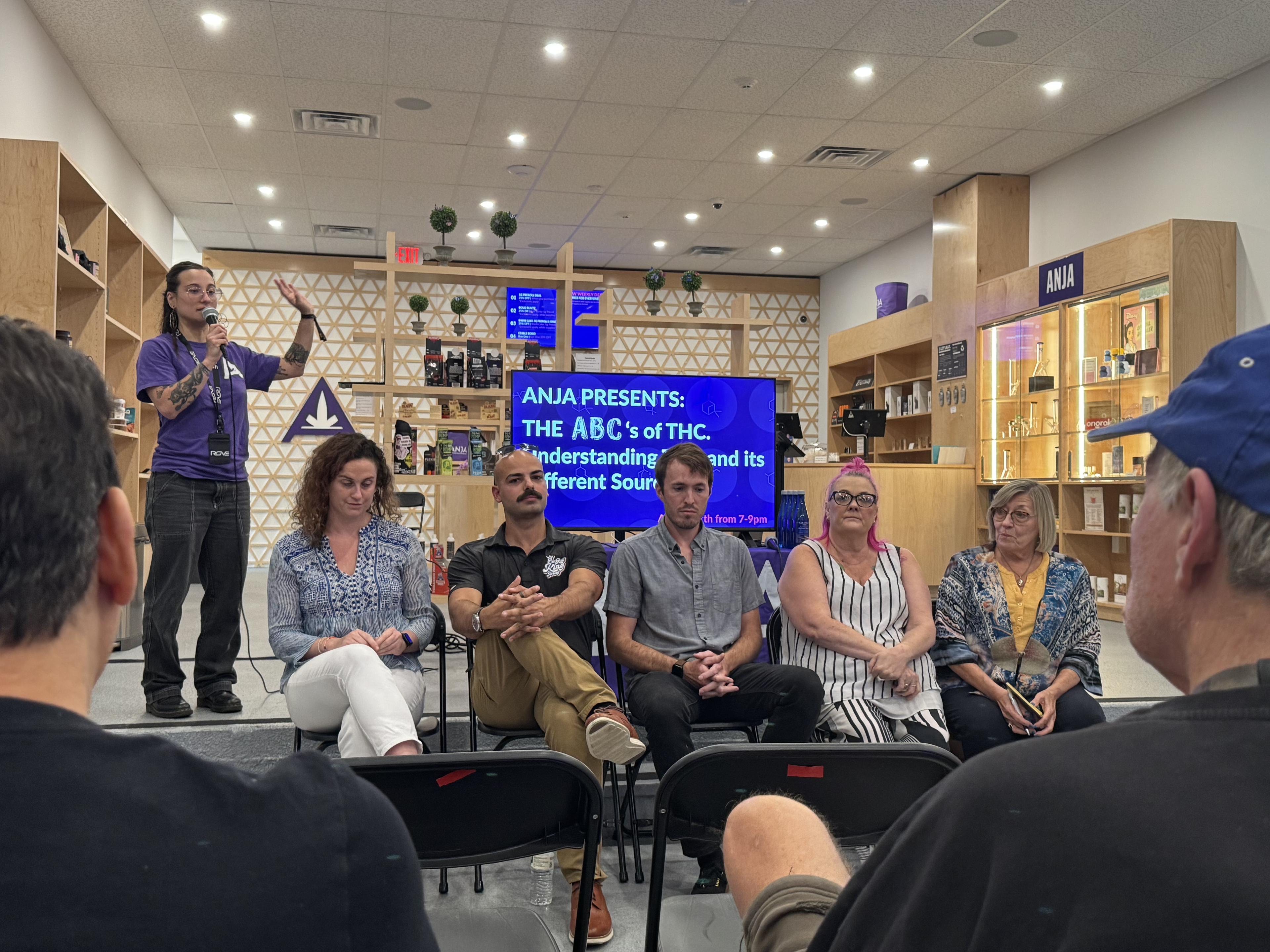
So we hosted an event to break it down. On Wednesday, August 27, ANJA and Rosin King of Jersey presented "The ABCs of THC: Understanding THC and Its Different Sources" at our Highland Park store. We brought together five people who work with this plant from very different angles: a cannabis geneticist, a New Jersey industry leader, a hemp cultivator, a licensed-market cultivator, and a plant-science researcher. This guide grew out of that conversation. Our goal is simple: give you an honest, plant-nerd-friendly map of the landscape so you can make informed choices, wherever you shop.
A note on what this article is and is not. This is educational information about how these compounds and categories are defined and regulated. It is not health, medical, or dosing advice, and nothing here is a claim that any product is safe, safer, or more effective than any other. Where the facts get technical or where the rules are still shifting, we say so.
First, the plot twist: hemp and marijuana are the same plant
One of the clearest takeaways from the night: "hemp" and "marijuana" are not two different plants. They are both Cannabis sativa L., the same species. The difference between them is not botanical. It is a legal line drawn around how much of one specific compound the plant contains.
Under the 2018 federal Farm Bill (the Agriculture Improvement Act of 2018), "hemp" is legally defined as cannabis containing no more than 0.3 percent delta-9 THC by dry weight. Anything above that line is legally "marijuana." Same plant, same genus and species, two legal buckets separated by a number.
That single threshold is the hinge that the entire "gas station weed" conversation turns on, so it is worth sitting with. The plant does not know about the 0.3 percent rule. The rule is a human decision about classification, and, as our panel put it, categories like these are human inventions that science, industry, and everyday consumers all use a little differently.
THC is not just one thing: a quick cannabinoid glossary
"THC" gets used as if it names a single compound. It is closer to a family. Here is the short, honest version of the ones that come up most.
Delta-9 THC. The primary intoxicating cannabinoid most people mean when they say "THC." It is
the compound the 0.3 percent legal line is measured against.
THCA (tetrahydrocannabinolic acid). The acidic form the living plant actually produces.
Raw, unheated cannabis is high in THCA, which is not intoxicating on its own. When you apply heat (smoking, vaping, cooking), THCA converts to delta-9 THC through a process called decarboxylation. This is why a Certificate of Analysis often lists both THCA and delta-9 separately, and why "total THC" is usually calculated from both. This is also the crux of the "THCA flower" label question: flower can test under 0.3 percent delta-9 while still being rich in THCA that becomes intoxicating once it is heated.
Delta-8 THC. A close chemical relative (an isomer) of delta-9. Small amounts occur naturally
in the plant, but the delta-8 products commonly sold outside licensed dispensaries are typically made by chemically converting CBD (which is abundant in hemp) into delta-8. It is intoxicating, though many users describe it as milder than delta-9.
Delta-10 THC and other converted cannabinoids. Like delta-8, these are usually produced
through conversion processes rather than harvested in meaningful amounts from the plant.
"Hemp-derived delta-9." Products that stay at or under 0.3 percent delta-9 by dry weight, but
are formulated (often as gummies or drinks where total weight is high) so that the actual delta-9 dose per serving is still meaningful. Legal by the weight math, intoxicating in practice.
None of this makes hemp-derived cannabinoids the villain of the story. They are real compounds that real people use. The point our panel kept returning to was not "good versus bad." It was "know your source, and know what has actually been tested."
Where "gas station weed" comes from
The reason intoxicating hemp products showed up so quickly in convenience stores comes down to that Farm Bill line plus some clever chemistry. Because hemp (and compounds derived from it) sits in a different legal category than marijuana, a large market grew up around extracting CBD from hemp and converting it into intoxicating cannabinoids like delta-8, or around high-THCA hemp flower that tests under the delta-9 limit.
Our hemp-industry panelist walked through how the industry isolates and distributes cannabinoid "isolates," and our geneticist pointed to the pockets where clear regulation simply has not caught up yet. Meanwhile, our New Jersey panelists talked through what the state is doing to address these products and how the hemp and licensed-cannabis worlds interact today and might interact in the future. That regulatory gap, not the plant, is the real subject.
What "regulated" actually means: testing and labeling
Here is where the practical difference between the two markets shows up, and we are going to keep this strictly factual.
Products sold through New Jersey's licensed adult-use system are required to go through state-mandated laboratory testing before they reach the shelf, and each product carries a Certificate of Analysis (COA): the lab document that reports what testing found. A COA typically reports:
Cannabinoid potency, including delta-9 THC, THCA, total THC, CBD, and other cannabinoids, so
the number on the package reflects a lab measurement rather than a guess.
Contaminant screening. State cannabis testing programs generally require screening for
categories such as pesticides, residual solvents, heavy metals, microbial contaminants, and mycotoxins.
Product identity details like batch or lot numbers that tie the package back to a specific
tested batch.
The unregulated hemp-intoxicant space is different in one factual respect that matters: there is no single, uniform, state-enforced testing-and-labeling standard equivalent to the licensed cannabis program governing every "THCA flower" or "delta-8" product on every counter. Some sellers test and publish results; others may not, and the requirements vary. That is a documented regulatory difference, and it is the reason our team encourages reading the label and asking where the numbers come from.
We want to be precise here, because it matters: the takeaway is not that one category is "safe" and another is not. Testing and regulation are not the same thing as a safety guarantee, and we are not making that claim. The honest, verifiable point is narrower and more useful: in the licensed market, what is on the label has been measured by a lab against state requirements and documented in a COA, and in the unregulated space that is not uniformly true. What you do with that difference is your call.
How to read a COA without a chemistry degree
Since the "THCA percentage" question is what started all of this, here is a plain-language way to approach a Certificate of Analysis:
Find total THC, not just one line. Because THCA converts to delta-9 when heated, "total THC"
(which accounts for both) is usually the most honest picture of how a flower product will behave. 2. Check that the COA matches the product. Look for a batch or lot number that ties the document to what is actually in your hand, and a reasonably recent test date. 3. Look for the contaminant sections, not just potency. Potency tells you strength. The pesticide, solvent, heavy-metal, and microbial sections tell you what the lab screened for. 4. When in doubt, ask. Our team reads these documents every day and is happy to walk through one with you.
Meet the panel
The night worked because of who was in the room. Our sincere thanks to:
Dr. Anna Schwabe, cannabis geneticist. She holds a PhD in Biological Education with expertise
in plant genetics and phenotypic variation, is an Associate Professor at the University of Colorado, serves as COO of CannaGen, and is CSO of True Cut.
Dr. Marianne Bays, New Jersey industry leader. An industry consultant and analyst working in
regulated cannabis since 2008, she is a founding board member and Vice President of the New Jersey CannaBusiness Association and CEO of Northeast Corridor Provisions.
Matthew Spitzer, hemp cultivator. A plant-cultivation professional with over a decade of
greenhouse experience, he founded Triangle Hemp and has provided genetics to growers nationwide.
Dominic Galanti, representing Glass Meadows as "The Rosin King of New Jersey." A Penn State
graduate with a B.S. in Plant Science and extensive cultivation and leadership experience.
Tori Rosen, who opened the night with an intro presentation. She is a PhD candidate at Rutgers
University studying plant-derived natural products, and she teaches a summer course in Hemp Cultivation and Post-Harvest Handling.
Alexandra Verello, ANJA's Sourcing Manager and the evening's moderator. A Rutgers alum,
adjunct professor, and former New Jersey medical-market cultivator of more than five years.
The bottom line
The plant is one plant. The categories, hemp and marijuana, delta-8 and delta-9, THCA and total THC, are the human part, and they are exactly where the confusion lives. The most useful thing you can do as a shopper is know which category a product falls into, know whether it has a COA, and know how to read it.
That is the whole reason ANJA exists as an education-first, community-first dispensary in Highland Park. Come in with your questions. Our budtenders will actually answer them, and if you want to pull up a COA together, we will. Visit us in store, order for delivery, or use our drive-up pickup window, and follow @anjapurp for the next event.
This article is general education for adults 21 and older. It is not medical advice, and cannabis affects everyone differently.
Ready to shop?
Delivery, drive-up pickup, or in-store in Highland Park.